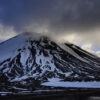
 Tongariro National Park is the oldest national park in New Zealand, located in the central North Island. It has a dual World Heritage status which recognises the park’s important Maori cultural and spiritual associations as well as its outstanding volcanic features. In 1993 Tongariro became the first property to be inscribed on the World Heritage List under the revised criteria describing cultural landscapes. The mountains at the heart of the park have cultural and religious significance for the Maori people and symbolize the spiritual links between this community and its environment. The park has active and extinct volcanoes, a diverse range of ecosystems and some spectacular landscapes.
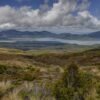
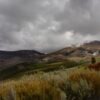
Tongariro National Park was the fourth national park established in the world. In 1886 in order to prevent the selling of the mountains to European settlers, the local Ngati Tuwharetoa iwi had the mountains surveyed in the Native Land Court and then set aside as a reserve in the names of certain chiefs one of whom was Te Heuheu Tukino IV, the most significant chief of the Māori Ngati Tuwharetoa iwi. Later the peaks of Mount Tongariro, Mount Ngauruhoe, and parts of Mount Ruapehu, were conveyed to The Crown on 23 September 1887, on condition that a protected area was established there.
This 26.4 km² area was generally considered to be too small to establish a national park after the model of Yellowstone National Park in Wyoming (USA), and so further areas were acquired. When the Parliament of New Zealand passed the Tongariro National Park Act in October 1894, the park covered an area of about 252.13 km², but it took until 1907 to acquire the land. When the Act was renewed in 1922, the park area was extended to 586.8 km². Further extensions, especially Pihanga Scenic Reserve in 1975, enlarged the park to its current size of 795.98 km². The last modification to the Act was passed in 1980. Tongariro National Park has been under the control of the New Zealand Department of Conservation since the creation of the department in 1987. There are a number of Māori religious sites within the park and the summits of Tongariro, including Ngauruhoe and Ruapehu, are sacred for them.
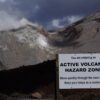
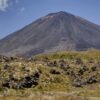
The active volcanic mountains Ruapehu, Ngauruhoe, and Tongariro are located in the centre of the park. Tongariro National Park lies in the heart of the North Island of New Zealand. It is just a few kilometres west-southwest of Lake Taupo. It contains a considerable part of the North Island Volcanic Plateau. Directly to the east stand the hills of the Kaimanawa range. The Whanganui River rises within the park and flows through Whanganui National Park to the west.
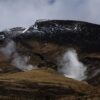
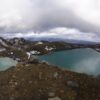
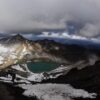
The active group extends for some 20 km along a south-west to north-east axis, with a width of some 10 km, and comprises Tongariro, Ngauruhoe and Ruapehu volcanoes. The Tongariro complex consists of recent cones, craters, explosion pits, lava flows and lakes superimposed on older volcanic features. In addition to these major features, the park contains other extinct volcanoes, lava and glacial deposits and a variety of springs. Extensive glaciation up to 14,700 years ago eroded both Tongariro and Ruapehu and glacial valleys with terminal and lateral moraine formations are present. Glaciers are currently restricted to Mount Ruapehu, although all are less than 1 km in length after several decades of retreat.
Habitats are diverse, ranging from remnants of rainforest to practically barren ice fields. From the lowest altitudes to 1,000 m in the west and north, about 3,000 ha of once widespread mixed podocarp-broadleaf rainforest is present. At higher altitudes beech forest occurs.
Scrublands cover some 9,500 ha. Tussock shrubland and tussockland cover extensive areas in the north-west and around the mount Ruapehu massif at about 1,200-1,500 m. The highest altitudes in the park are dominated by gravelfields and stonefields. The vertebrate fauna is restricted mainly to birds although native mammals are represented by short-tailed and long-tailed bats. More than 56 bird species have been recorded in the park, including brown kiwi and North Island fern bird.
The area has been occupied by Maoris since they first arrived from Polynesia and ethnic mythology identifies the mountains in the park with tupuna (god-like ancestors). Until the land was given to the nation in 1887, it was occupied by the Tu Wharetoa tribe.
Coming expeditions that could take you there:
- Photoexpedition Australia – New Zealand :: November 2013
- Photoexpedition Australia – New Zealand :: December 2013/January 2014
We have been here:
- in 2012 during Solar Eclipse Expedition Australia & New Zealand


Sources:
UNESCO World Heritage Centre
New Zealand Department of Conservation
Wikipedia
Leave a Reply