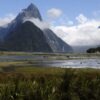
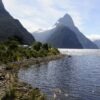
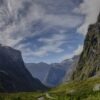
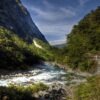
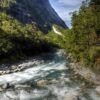
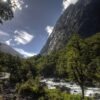
 One of New Zealand’s most beautiful, vast and wild places Fiordland National Park has spectacular ice-carved fiords, lakes and valleys, rugged granite tops and pristine mountain to sea vistas. This National Park has been established in 1952 and covers an area of 12,500 km² and is the largest park in New Zealand. Fiordland National Park lies in the south-western corner of New Zealand’s South Island. Fiordland National Park is special not only in New Zealand but is also internationally recognised as part of Te Wāhipounamu – South West New Zealand World Heritage Area.

Te Wähipounamu – South West New Zealand is considered to be the best modern example of the primitive taxa of Gondwanaland seen in modern ecosystems – and as such the property is of global significance. The progressive break-up of the southern super-continent of Gondwanaland is considered one of the most important events in the earth’s evolutionary history. New Zealand’s separation before the appearance of marsupials and other mammals, and its long isolation since, were key factors enabling the survival of the ancient Gondwanan biota on the islands of New Zealand to a greater degree than elsewhere. The living representatives of this ancient biota include flightless kiwis, carnivorous land snails, 14 species of podocarp and genera or beech.
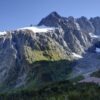
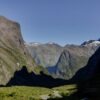
During the cooler past glaciers carved many deep fiords, the most famous of which are Milford, Doubtful and Dusky Sounds. Fiordland’s coast is steep and crenellated, with the fiords running from the valleys of the southern ranges of the Southern Alps, such as the Kepler and Murchison Mountains. At the northern end of the park, several peaks rise to over 2,000 metres.
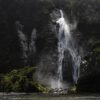
Ice has carved islands from the mainland, leaving two large uninhabited offshore islands, Secretary Island and Resolution Island. Several large lakes lie wholly or partly within the park’s boundaries, notably Lake Te Anau, Lake Manapouri, Lake Monowai, Lake Hauroko, and Lake Poteriteri. The Sutherland Falls, to the southwest of Milford Sound on the Milford Track, measuring 580 meters are among the world’s highest waterfalls.
Prevailing westerly winds blow moist air from the Tasman Sea onto the mountains; the cooling of this air as it rises produces a prodigious amount of rainfall, exceeding seven metres in many parts of the park. This supports the lush temperate rain forests of the Fiordland temperate forests ecoregion.
We have been here:
- in 2012 during Solar Eclipse Expedition Australia & New Zealand
- Photoexpedition Australia – New Zealand :: November 2013
- Photoexpedition Australia – New Zealand :: December 2013/January 2014
Sources:
UNESCO World Heritage Centre
New Zealand Department of Conservation

Leave a Reply