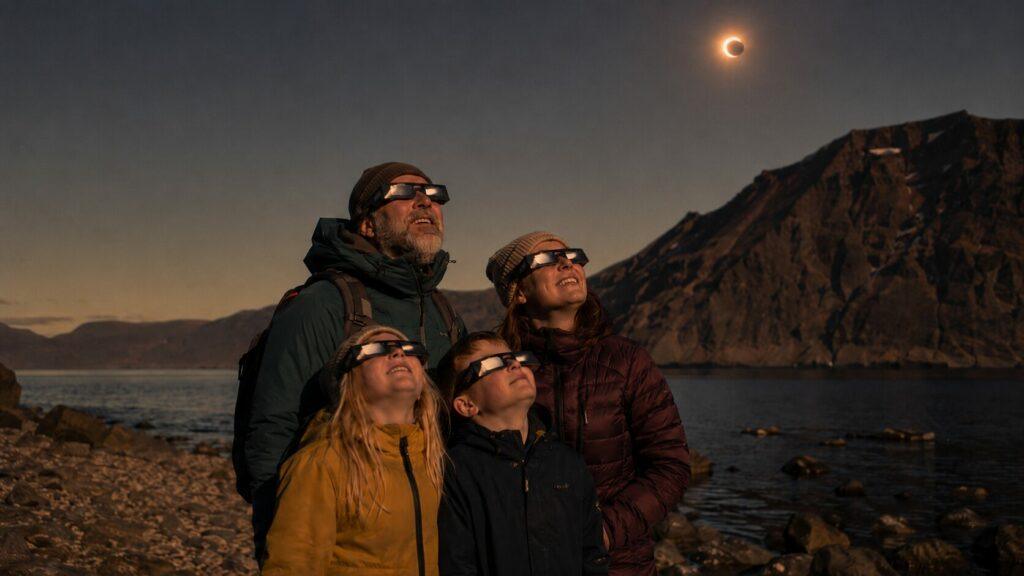
Observer une éclipse solaire est une expérience inoubliable, mais cela doit se faire en toute sécurité. Le Soleil peut gravement endommager vos yeux si vous le regardez sans protection appropriée, même lorsque la plus grande partie de son disque est couverte par la Lune. La sécurité lors de l’observation d’une éclipse est simple, mais elle demande une préparation avant l’événement.
Ce guide explique les règles de sécurité de base pour observer une éclipse solaire, notamment comment utiliser les lunettes d’éclipse, quand les filtres sont nécessaires, comment protéger les appareils photo et les jumelles, et ce que les voyageurs doivent retenir avant le jour de l’éclipse.
Pourquoi la sécurité pendant l’observation d’une éclipse est importante
Pendant une éclipse solaire, la Lune bloque une partie ou la totalité du Soleil de notre point de vue. Cela peut donner l’impression que le Soleil est moins lumineux, mais cela ne rend pas l’observation directe sûre pendant les phases partielles. La lumière solaire nocive peut encore atteindre vos yeux et endommager la rétine, le tissu sensible à la lumière situé au fond de l’œil.
Les lésions oculaires causées par une observation solaire non protégée peuvent ne pas être douloureuses au moment où elles se produisent. C’est l’une des raisons pour lesquelles la sécurité pendant une éclipse est si importante. Il ne faut jamais tester ses yeux en jetant un rapide coup d’œil au Soleil sans protection appropriée.
La règle principale : ne jamais regarder le Soleil sans protection appropriée
La règle la plus importante est simple : ne regardez jamais directement le Soleil sans protection certifiée pour l’observation solaire. Cela s’applique avant l’éclipse, pendant les phases partielles et après la fin de la totalité.
Les lunettes de soleil ordinaires ne sont pas sûres pour l’observation solaire. Les lunettes de soleil foncées, les lunettes polarisantes, le verre fumé, les films exposés, les CD et les filtres faits maison ne fournissent pas une protection adéquate.
Pour regarder directement le Soleil, utilisez des lunettes spéciales pour éclipse ou une visionneuse solaire tenue à la main conforme à la norme internationale de sécurité ISO 12312-2.
Quand peut-on regarder sans lunettes d’éclipse ?
Vous pouvez regarder l’éclipse sans lunettes d’éclipse uniquement pendant la brève période de totalité, et seulement si vous vous trouvez dans la bande d’une éclipse solaire totale. La totalité se produit lorsque la Lune recouvre complètement la face brillante du Soleil.
Si vous observez une éclipse solaire partielle, vous devez utiliser une protection oculaire appropriée pendant toute la durée de l’événement. Si vous observez une éclipse solaire annulaire, vous devez également utiliser une protection oculaire appropriée pendant toute la durée de l’événement, car l’anneau brillant du Soleil reste visible.
Dès que la totalité se termine et qu’une infime partie du Soleil brillant réapparaît, vous devez remettre immédiatement vos lunettes d’éclipse.
Comment utiliser correctement les lunettes d’éclipse
Les lunettes d’éclipse sont faciles à utiliser, mais elles doivent être manipulées correctement.
- Vérifiez les lunettes avant l’éclipse. Ne les utilisez pas si elles sont rayées, déchirées, perforées, desserrées ou endommagées.
- Mettez les lunettes avant de lever les yeux vers le Soleil.
- Gardez les lunettes pendant que vous regardez le Soleil.
- Détournez le regard du Soleil avant de retirer les lunettes.
- Surveillez attentivement les enfants et assurez-vous que leurs lunettes tiennent bien en place.
Ne marchez pas, ne conduisez pas et ne vous déplacez pas en portant des lunettes d’éclipse. Elles bloquent presque toute la lumière normale, vous risquez donc de ne pas voir clairement les obstacles, les marches, la circulation ou les autres personnes.
Achetez des lunettes d’éclipse auprès d’une source fiable
Les lunettes d’éclipse sûres doivent respecter la norme ISO 12312-2, mais l’étiquette seule ne suffit pas si le produit provient d’un vendeur inconnu ou peu fiable. Des lunettes d’éclipse contrefaites ou de mauvaise qualité peuvent sembler convaincantes.
Achetez des lunettes d’éclipse auprès de fournisseurs réputés, de magasins d’astronomie, de centres scientifiques, d’observatoires ou d’organisateurs d’événements de confiance. Évitez les achats de dernière minute sur des annonces en ligne aléatoires, surtout si le vendeur n’identifie pas clairement le fabricant.
Observation sûre pour les enfants
Les enfants ont besoin d’une surveillance supplémentaire pendant une éclipse. Ils peuvent être excités, distraits ou tentés de regarder par les côtés des lunettes d’éclipse.
Avant le début de l’éclipse, expliquez les règles avec des mots simples :
- Ne regarde pas le Soleil sans lunettes d’éclipse.
- Mets les lunettes avant de regarder vers le haut.
- Regarde vers le bas avant d’enlever les lunettes.
- N’utilise pas de lunettes endommagées.
- Demande l’aide d’un adulte avant d’utiliser des jumelles, un télescope ou un appareil photo.
Pour les jeunes enfants, les méthodes d’observation indirecte, comme les projecteurs à sténopé, peuvent être plus sûres et plus faciles à gérer.
Observation indirecte : une alternative sûre
Vous n’avez pas besoin de regarder directement le Soleil pour profiter d’une éclipse. L’observation indirecte est une option sûre et simple, en particulier pour les familles, les écoles et les événements publics.
Un projecteur à sténopé laisse passer la lumière du Soleil à travers un petit trou et projette une image du Soleil éclipsé sur une surface. Vous pouvez en fabriquer un avec du carton, du papier, ou même utiliser les petits espaces entre les feuilles d’un arbre. Pendant une éclipse partielle, les taches de lumière projetées peuvent apparaître sous forme de petits croissants.
Ne regardez jamais le Soleil à travers le trou. Le but est de regarder l’image projetée, et non de regarder à travers l’ouverture.
Utiliser les appareils photo, les jumelles et les télescopes en toute sécurité
Les appareils photo, les jumelles et les télescopes nécessitent une attention particulière. Regarder le Soleil à travers un appareil optique sans filtre solaire approprié peut provoquer très rapidement de graves lésions oculaires.
Les lunettes d’éclipse ne suffisent pas lorsque vous utilisez des jumelles, des télescopes, des objectifs d’appareil photo ou des longues-vues. Ces instruments concentrent la lumière solaire et peuvent endommager à la fois vos yeux et votre matériel.
Utilisez un filtre solaire approprié, solidement fixé à l’avant de l’objectif, du télescope ou des jumelles, avant que la lumière du Soleil n’entre dans le système optique. Ne placez pas un filtre uniquement près de l’oculaire, sauf si le fabricant de l’équipement l’a spécialement conçu pour cet usage.
Filtres solaires pour la photographie
Si vous prévoyez de photographier l’éclipse, protégez votre appareil photo aussi bien que vos yeux. Un puissant téléobjectif pointé vers le Soleil peut concentrer une lumière intense sur le capteur de l’appareil.
Utilisez un filtre solaire certifié à l’avant de l’objectif pendant toutes les phases partielles. Retirez le filtre uniquement pendant la totalité, et seulement si vous photographiez une éclipse solaire totale depuis l’intérieur de la bande de totalité. Remettez le filtre avant la fin de la totalité.
Entraînez-vous à ce processus avant le jour de l’éclipse. La totalité peut ne durer que quelques minutes, et vous ne voulez pas apprendre à utiliser votre matériel au moment le plus important.
Sécurité pendant la totalité
La totalité est le seul moment où le disque brillant du Soleil est entièrement couvert par la Lune. Pendant cette courte période, les observateurs situés dans la bande de totalité peuvent regarder l’éclipse sans visionneuse solaire et voir la couronne solaire.
Le timing reste toutefois essentiel. Connaissez les heures locales exactes de début et de fin de la totalité pour votre lieu d’observation. Utilisez une application fiable consacrée aux éclipses, un horaire imprimé ou les annonces d’un événement organisé.
Lorsque la totalité est sur le point de se terminer, cessez de regarder directement l’éclipse et remettez vos lunettes d’éclipse avant le retour du Soleil brillant.
Erreurs courantes de sécurité pendant une éclipse
De nombreux problèmes de sécurité pendant les éclipses viennent d’erreurs simples. Évitez ces erreurs fréquentes :
- Utiliser des lunettes de soleil ordinaires au lieu de lunettes d’éclipse.
- Acheter des lunettes d’éclipse auprès d’un vendeur inconnu.
- Utiliser des visionneuses solaires rayées ou endommagées.
- Regarder à travers des jumelles ou un télescope en portant des lunettes d’éclipse.
- Retirer la protection oculaire trop tôt avant la totalité.
- Oublier de remettre la protection oculaire lorsque la totalité se termine.
- Laisser des enfants observer sans surveillance étroite.
- Essayer de prendre des photos avec un appareil photo ou un objectif de téléphone sans filtre.
Conseils de sécurité en voyage pour les observateurs d’éclipse
Si vous voyagez pour voir une éclipse, prévoyez votre matériel de sécurité avant le départ. Les lunettes d’éclipse peuvent être épuisées près des lieux d’observation populaires.
- Prévoyez des lunettes d’éclipse pour chaque personne de votre groupe.
- Apportez quelques paires de rechange au cas où l’une serait endommagée.
- Gardez les lunettes à plat et protégées dans vos bagages.
- Emportez un horaire imprimé des heures de l’éclipse pour votre lieu d’observation.
- Arrivez tôt pour éviter de préparer votre installation dans la précipitation.
- Apportez de l’eau, de la crème solaire, un chapeau et des vêtements adaptés à la météo.
- Choisissez un lieu d’observation à l’écart de la circulation et des bords dangereux.
- Ne conduisez pas en regardant l’éclipse.
Les grands événements liés aux éclipses peuvent attirer des foules et provoquer de la circulation. Prévoyez suffisamment de temps pour rejoindre votre site d’observation, installer votre matériel et revoir les règles de sécurité avec votre groupe.
Que faire si vous pensez avoir regardé le Soleil sans protection ?
Si vous avez accidentellement regardé le Soleil sans protection appropriée et que vous remarquez une vision floue, des taches sombres, une vision déformée ou des changements dans la perception des couleurs, contactez un professionnel de la vue dès que possible.
N’essayez pas de diagnostiquer le problème vous-même. Les symptômes oculaires après une observation solaire non protégée doivent être pris au sérieux, même en l’absence de douleur.
Checklist rapide de sécurité pour une éclipse
- Utilisez des lunettes d’éclipse ou des visionneuses solaires tenues à la main conformes à la norme ISO 12312-2.
- N’utilisez pas de lunettes de soleil ordinaires.
- Inspectez les lunettes d’éclipse avant utilisation.
- Mettez les lunettes avant de regarder le Soleil.
- Détournez le regard avant de retirer les lunettes.
- Utilisez des filtres solaires sur les appareils photo, les jumelles et les télescopes.
- Utilisez des méthodes d’observation indirecte si vous n’avez pas de lunettes sûres.
- Surveillez les enfants à tout moment.
- Connaissez l’heure exacte de la totalité si vous observez une éclipse solaire totale.
- Remettez immédiatement la protection oculaire lorsque la totalité se termine.
Conclusion
Une éclipse solaire est l’un des plus beaux phénomènes naturels que l’on puisse observer, mais la sécurité doit passer avant tout. Utilisez des lunettes d’éclipse appropriées, évitez les filtres faits maison, protégez les appareils photo et les instruments optiques, et surveillez attentivement les enfants.
L’expérience d’éclipse la plus sûre est celle que vous préparez à l’avance. Avec la bonne protection et un plan clair, vous pouvez profiter de l’éclipse en toute confiance et vous concentrer sur le spectacle rare qui se déroule dans le ciel.
Questions fréquentes sur la sécurité pendant l’observation d’une éclipse
Puis-je observer une éclipse solaire avec des lunettes de soleil ordinaires ?
Non. Les lunettes de soleil ordinaires ne sont pas sûres pour regarder directement le Soleil pendant une éclipse solaire. Utilisez des lunettes d’éclipse ou une visionneuse solaire tenue à la main conforme à la norme ISO 12312-2.
Puis-je regarder le Soleil pendant la totalité ?
Vous pouvez regarder sans lunettes d’éclipse uniquement pendant la brève période de totalité d’une éclipse solaire totale, et seulement lorsque le Soleil est complètement couvert par la Lune. Cela ne s’applique pas aux éclipses partielles ou annulaires.
Les lunettes d’éclipse suffisent-elles pour les jumelles ou les télescopes ?
Non. Ne regardez pas à travers des jumelles, des télescopes, des appareils photo ou des longues-vues en portant seulement des lunettes d’éclipse. Les instruments optiques ont besoin de filtres solaires appropriés fixés à l’avant de l’équipement.
Que dois-je faire si mes lunettes d’éclipse sont rayées ?
N’utilisez pas de lunettes d’éclipse rayées, déchirées, perforées ou endommagées. Remplacez-les par une paire sûre provenant d’une source fiable.
Un projecteur à sténopé est-il sûr ?
Oui, un projecteur à sténopé est une méthode d’observation indirecte sûre lorsqu’il est utilisé correctement. Regardez l’image projetée du Soleil, et non le Soleil à travers le trou.